Home > fabrics > asian / florals > item
Kei Temari — orange (half yard)
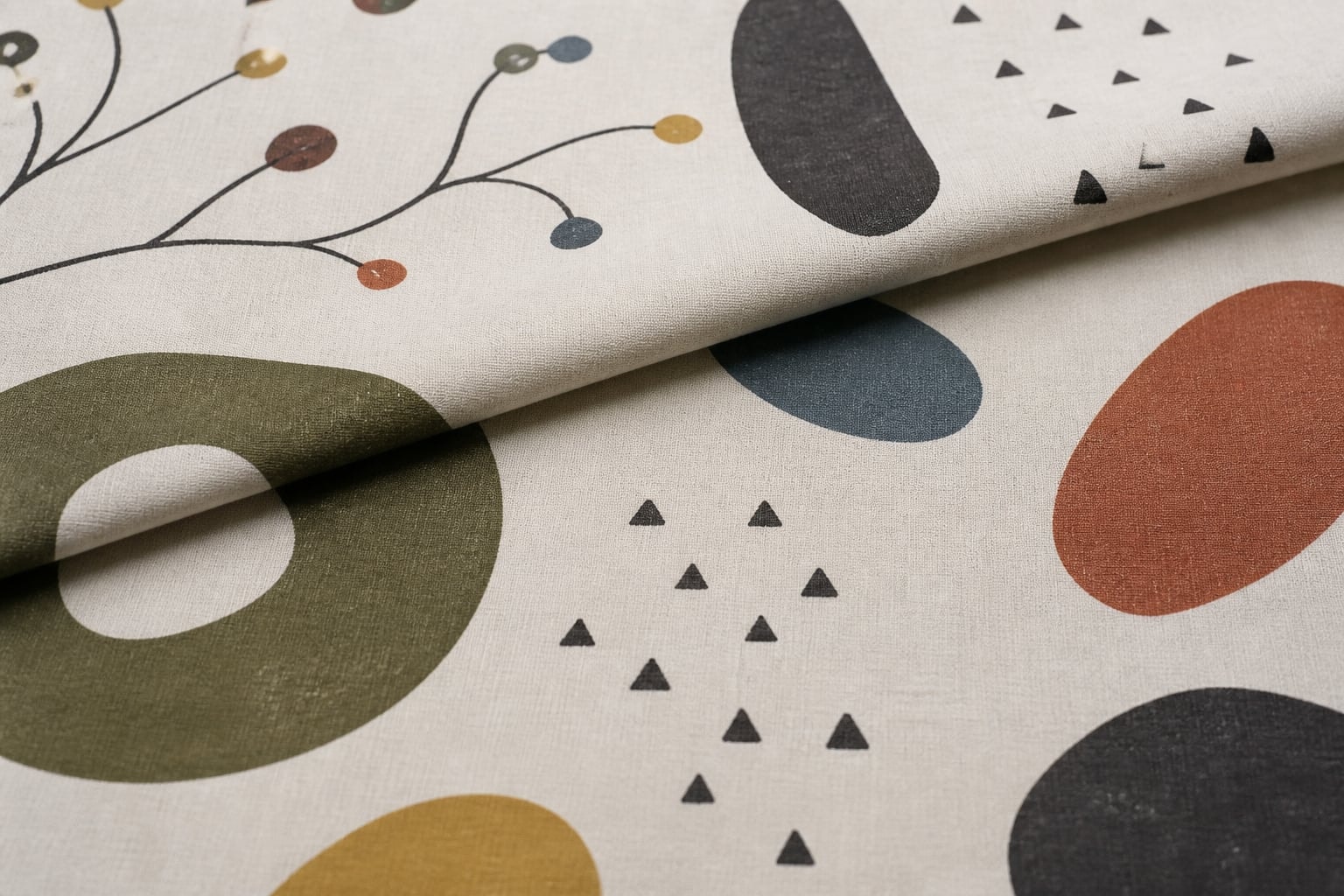
- fabric content
- 100% cotton
- fabric width
- 42–43 inches wide
- motif size
- larger balls about 4 inches wide
- fabric keywords
- Japanese import, geometric, dots, spots
- historical unit
- listed by the half yard (18 inches)
- catalog code
- KTMRG
In 2008, this fabric was categorized under Asian fabrics and florals. Its title and concise specification block identify cotton content, width, motif size, keywords, half-yard unit, and catalog code.
What the listed details establish
The listing establishes cotton content, a slightly narrower-than-default width, a four-inch scale for the larger ball motifs, and the catalog's own descriptive keywords. “Geometric, dots, spots” suggests that the design was read both as a field of rounded forms and as a repeating abstract pattern. The title's orange color descriptor distinguishes this orange colorway without claiming that an original sample is shown here.
A four-inch dominant motif is large enough to remain legible across a moderate panel but small enough to repeat several times across the stated width. That is an interpretation of the listed dimensions, not a new product specification.
The half-yard unit equals 18 inches along the length of the cloth, while the listed 42–43 inches describes its width. Those measurements refer to different directions and should not be mistaken for repeat dimensions. No horizontal or vertical repeat interval appears in the specification block.
The category and keyword vocabulary overlaps deliberately. Asian fabrics and florals describe browsing paths; Japanese import, geometric, dots, and spots describe origin grouping and visible motif families. Together they show how one fabric could sit in several parts of the catalog without changing its technical record.
Reading an item record responsibly
The safest approach is to separate what the listing states from what a modern reader infers. Here, content, width, motif scale, keywords, unit, and item code are catalog facts. Condition, present color accuracy, manufacturing method, availability, and suitability for a particular project are unknown.
Return to all Japanese import fabric for the related category context, or to fabrics for the broader historical taxonomy.