Buttons and Patches
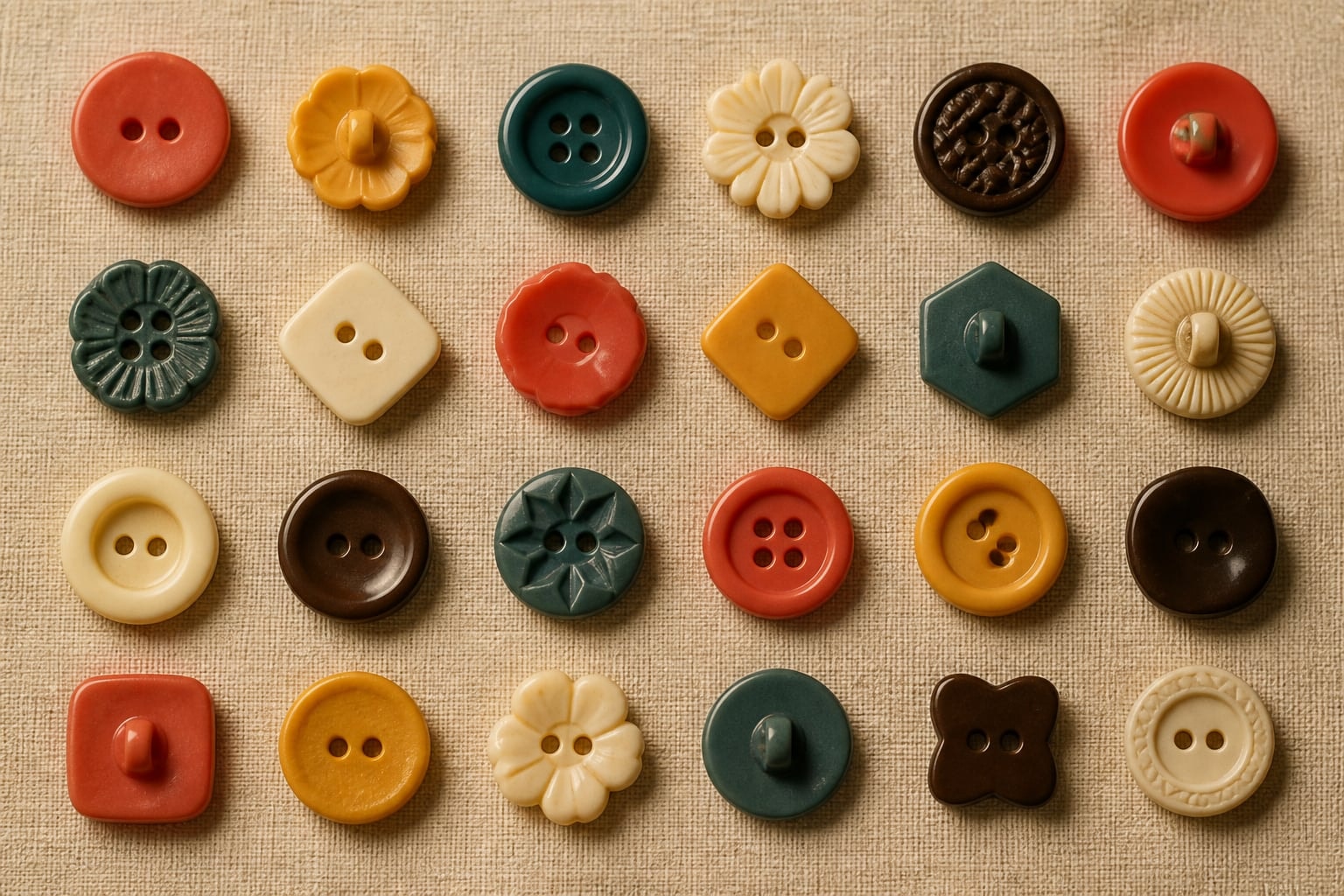
The 2002 “Buttons and Patches” category offered three simple routes: Button Sets, Single Buttons, and Patches and Appliques. Together they placed coordinated groups, individual fasteners, and decorative surface additions within the same notions department.
- Button Setshistorical subcategory
- Single Buttonshistorical subcategory
- Patches and Appliqueshistorical subcategory
The three-part structure supports a practical way to study buttons as small functional design objects. Outline, profile, surface, attachment, scale, and condition can be described without guessing at characters, makers, collections, materials, dates, or uses.
Read the form before guessing the material
A button can be described through outline, profile, surface, attachment, and scale. Common outlines include round, oval, square, elongated, and irregular novelty shapes. Profiles range from flat discs to domed forms and deeply modeled relief. The face may be smooth, faceted, carved, printed, molded, covered with cloth, or pierced by visible holes.
Attachment offers another observable distinction. Sew-through buttons have holes crossing the face, usually two or four. Shank buttons place a loop behind the face, allowing the front to remain uninterrupted. Some forms combine a decorative face with a separate attachment component. These descriptions are safer than identifying an unknown piece as a particular plastic, shell, glass, metal, or ceramic solely from a photograph. Surface sheen and molding marks can suggest questions, but they do not establish composition.
Novelty, geometry, and visual character
Retro buttons often gain their effect from compressed imagery. A flower becomes five rounded lobes around a contrasting center. An animal becomes a silhouette recognized through ears, tail, or stance. A simple starburst can evoke atomic-age graphics, while a carved line can turn an ordinary disc into a tiny piece of ornament. At button scale, clarity matters: an outline must remain legible even when the object is viewed from several feet away.
Generic visual terms are most useful when a maker or collection is uncertain. Generic terms such as animal silhouette, face motif, floral relief, or geometric novelty form keep attention on visual construction. The broad Library of Congress fashion resources provide a wider setting for studying how clothing details, patterns, photographs, and cultural records relate.
Buttons create rhythm
A single button is a focal point; a row becomes a rhythm. Equal spacing reinforces structure, while varied sizes or alternating colors create a more playful sequence. Strong contrast makes the closure line prominent. Low contrast lets it recede into the cloth. On a patterned ground, a button can echo a small accent color or deliberately oppose the dominant palette.
Scale should be judged against the entire field, not just the buttonhole. A large modeled shape may overwhelm a narrow band, while a tiny button can disappear beside a bold repeat. Paper circles cut to proposed diameters allow composition tests without handling fragile pieces repeatedly. The color principles in the canary yellow textile study and the scale framework in the retro fabrics guide apply just as well to notions.
Document the reverse
The back often contains the most useful structural evidence. Photograph front, side, and reverse under diffuse light. Include a neutral ruler without covering edges. Record diameter, thickness, number and position of holes, shank form, visible seams, chips, abrasion, corrosion, or thread remnants. Keep observation separate from interpretation, especially when a piece resembles a familiar era or material.
Groups deserve an additional record. Note whether dimensions and attachment systems match, whether surface wear is consistent, and whether colors appear to belong to one coordinated set. Similarity does not prove that pieces began together, but a careful group photograph preserves the relationship in which they were found.
Handling and care
Dust buttons with minimal friction and avoid soaking unknown materials. Moisture, solvents, heat, and aggressive polishing can change surfaces or disturb applied decoration. Metal components may stain adjacent cloth, while cracked attachments can place stress on old thread. The National Park Service textile-care handbook offers conservative principles for clean handling, support, and storage of textile objects and their components.
Loose buttons are best kept from knocking against one another, with enough support that projecting shanks do not carry weight. Buttons still attached to an older textile should be treated as part of that object. A qualified conservator can assess fragile, valuable, coated, corroded, or composite pieces.
A useful notions category
This category provides a focused notions reference. Shape, profile, attachment, scale, rhythm, and condition provide a clear vocabulary for studying retro buttons without inventing the identities of the pieces once represented here.