Aloha! 60" — black (half yard)
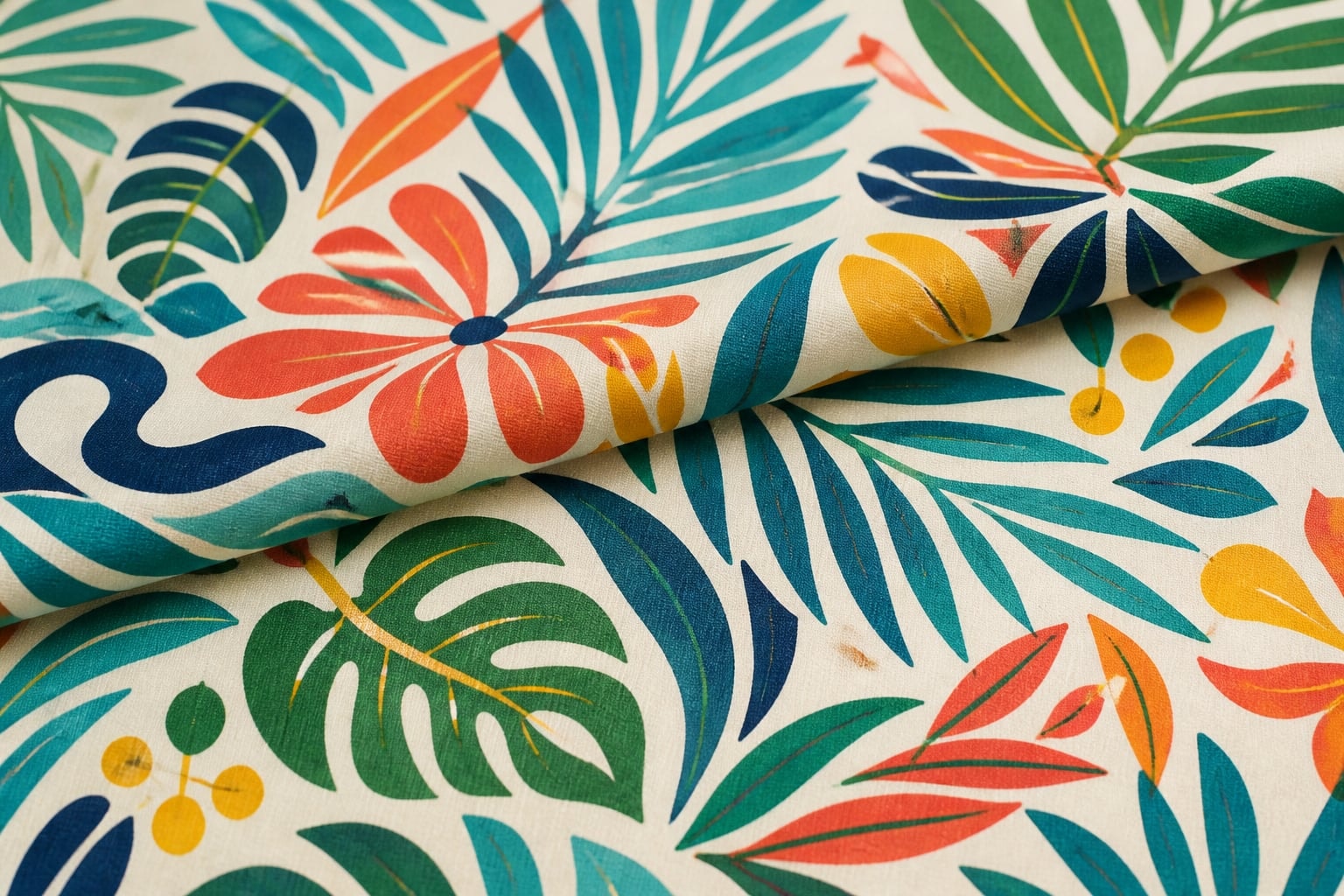
- catalog note
- out-of-print design
- fabric content
- 100% cotton
- fabric width
- 60 inches wide
- fabric keywords
- tropical, Hawaiian, Hawaii, hula figures, tiki
- historical unit
- listed by the half yard
- catalog code
- ALHBK
The 2010 product details included a full title, a short out-of-print note, cotton content, 60-inch width, keywords, half-yard unit, and item code. These details establish an unusually wide cotton print with a tropical subject and a half-yard catalog unit.
The guide below expands on motif, color, repeat, and respectful context for tropical textile design.
Tropical is a broad visual category
Tropical prints may include broad leaves, blossoms, fruit forms, waves, canoes, shoreline shapes, fish, birds, or abstract marks suggesting sun and water. Some are densely scenic; others isolate a few large botanical silhouettes. The word describes an image family, not a verified origin. Similar motifs have circulated through many textile traditions, regions, and revival periods.
Careful language identifies what is visible and leaves provenance open. A shape can be described as palm-like, petal-like, or wave-like when the exact species or source is unclear. This avoids turning stylization into false certainty and keeps attention on the pattern's actual construction.
Bold color and controlled proportion
1960s-inspired tropical prints often use assertive color relationships: orange beside pink, turquoise against green, yellow punctuating navy, or cream opening space around saturated leaves. Not every color needs equal area. A broad ground establishes atmosphere, secondary hues connect motifs, and a small high-contrast accent moves the eye through the repeat.
Value is the hidden structure. Two saturated hues of similar value may vibrate at their boundary but blend at distance. A pale blossom against a dark leaf remains distinct. Viewing a grayscale photograph helps reveal which motifs rely on light-dark contrast. The canary yellow color study offers a closer look at proportion, adjacency, and lighting.
Direction and repeat
Many tropical patterns are directional because stems rise, flowers face outward, or scenes have a horizon. Others rotate motifs so the cloth reads from multiple directions. To determine orientation, look beyond one flower and examine the shared movement of stems, leaves, and smaller filler shapes. A design can appear tossed at first while still having a subtle top.
Large repeats create dramatic fields but are vulnerable to cropping. A seam can separate a blossom from its leaves or interrupt the visual path of a wave. Small repeats survive compact panels more readily and become texture at distance. The fabric repeat and scale guide explains paper-window tests and repeat measurement.
What makes a print feel like the 1960s?
Period feeling may come from enlarged scale, high saturation, flattened silhouettes, loose brushlike edges, or a move away from delicate naturalism. Later-1960s design often embraced stronger optical effects and bolder color than the smaller patterns associated with the preceding decade. The V&A account of post-war textiles provides museum context for that change in scale and visual confidence.
These cues indicate resemblance, not age. Revival textiles can deliberately quote them, and cloth from the period can follow an entirely different visual language. A sound description says 1960s-inspired unless documentation establishes more.
Cultural context and evidence
Aloha textiles are connected with a specific cultural and geographic history, while broad tropical imagery has also been generalized far beyond it. When provenance is missing, avoid assigning a place of manufacture, cultural meaning, or traditional status from imagery alone. A motif is not proof of who designed, made, used, or named the cloth.
The Library of Congress fashion resources demonstrate how garments, sewing patterns, photographs, and other records can be studied together. For any textile, a dated photograph or documented label provides a stronger historical connection than visual resemblance by itself.
Recording and caring for a tropical print
Photograph the full repeat in diffuse light, then record closer views of registration, surface, reverse, edges, and condition. Record the direction and the dimensions of a dominant motif. Note whether fading is uniform or concentrated at folds and exposed areas. Do not increase saturation digitally in a documentary image without preserving the unaltered original.
Light can permanently alter dyes, and unknown finishes or previous treatments complicate cleaning. Keep older pieces supported, clean, and away from bright light. The National Park Service textile-care guidance provides general principles; uncertain or fragile pieces call for a qualified conservator.
A vivid pattern, carefully described
The lasting appeal of a tropical print lies in the movement between generous leaves, bright accents, and open ground. Describing those relationships makes this historical route useful while respecting the wider cultural context behind the word aloha.