Western Motif Vintage Fabric: Reading the Pattern
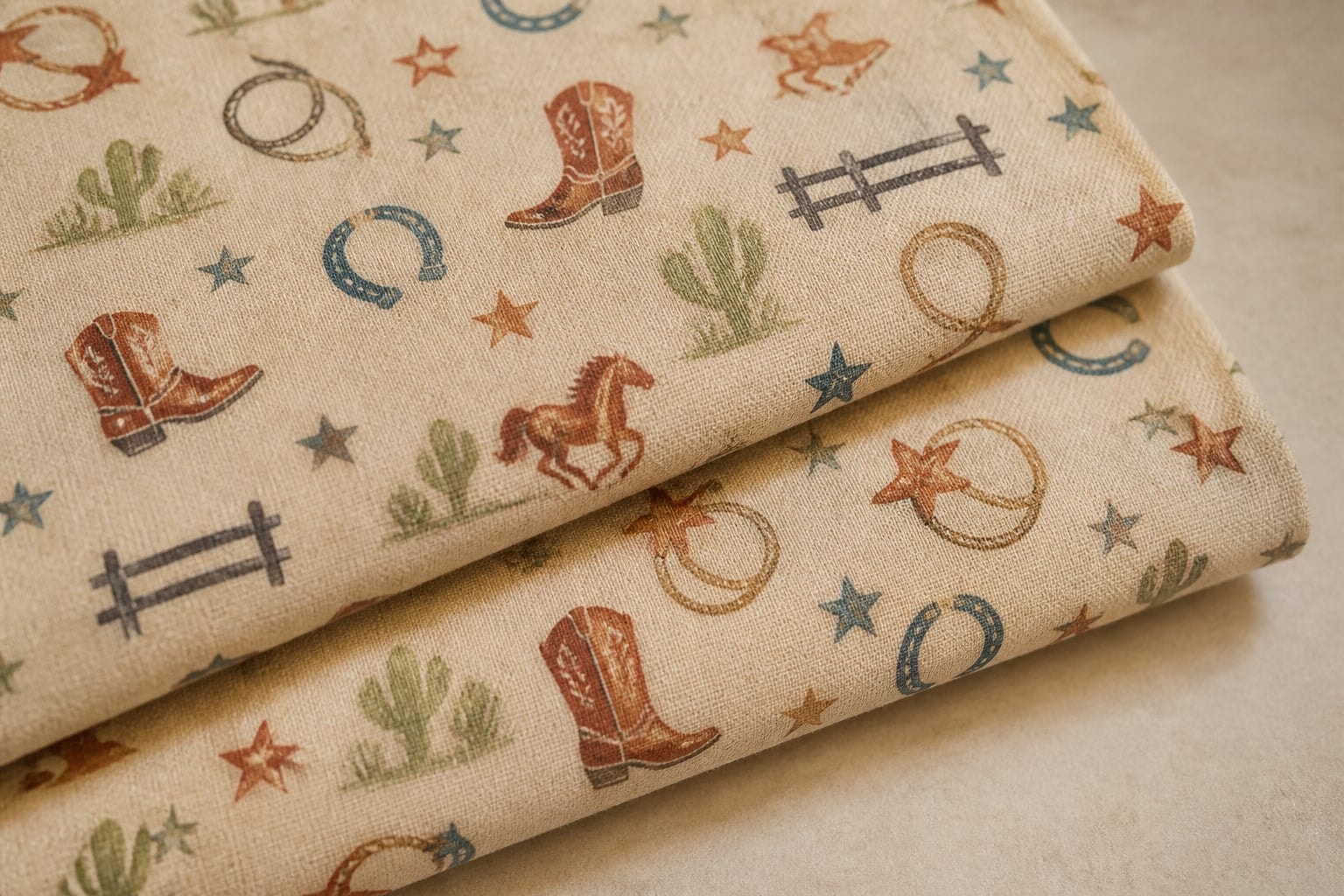
Western motif fabric creates narrative through recognizable forms, repeated scenes, palette, and scale. Boots, hats, horseshoes, stars, ropes, cacti, ranch buildings, and simplified landscapes can work as individual icons or combine into a conversational repeat.
A visual vocabulary of place and movement
Generic western patterns may use hats, boots, rope loops, stars, horseshoes, fences, desert plants, wagons, saddles, or riders reduced to silhouettes. Some focus on isolated objects; others build small scenic episodes. Curved rope lines lead the eye, star shapes act as punctuation, and hoof or wheel forms imply movement even within a static repeat.
These motifs should be described generically unless reliable documentation supports a specific title or source. Familiar imagery can resemble a known label, entertainment property, or collection without being connected to it. A careful description concentrates on formal features visible in the pattern.
Tossed motifs and scenic repeats
A tossed arrangement rotates objects so the design has no obvious top. That makes it adaptable to panels viewed from several directions. A directional scenic print aligns figures or landscapes along a shared baseline, producing a stronger sense of story but requiring careful orientation. Half-drop arrangements can disguise the boundary between scenes by shifting each column.
To find the repeat, choose an uncommon cluster rather than a single common star or dot. Trace where the cluster returns at the same angle. Then note whether the spaces between clusters form their own diagonal or grid. The fabric repeat guide provides a fuller method for measuring repeat, direction, and dominant motif scale.
Earth, sky, and accent colors
Western-inspired palettes often draw on earth and sky associations: clay red, sand, cream, brown, faded blue, sage, and charcoal. Yet an unexpected pink, turquoise, or clear yellow can shift the pattern from rustic to playful. The balance between ground and accent matters more than adherence to a fixed palette.
Value structure establishes readability. Dark silhouettes on a light ground remain clear at distance, while close mid-values create a softer, weathered effect. A bright accent can guide the eye between scattered objects. The canary yellow color reference explains how saturation and neighboring colors change the apparent strength of an accent.
Scale determines whether the story survives
Large scenes can lose key relationships when crossed by seams. Small conversational motifs repeat often enough to remain recognizable on compact panels but may merge into texture from afar. A transparent or paper window cut to the expected panel size offers a simple way to test cropping. Move it across several repeats and note whether any placement produces awkward fragments.
Folds also rewrite a scene. A horse-shaped silhouette may disappear into a pleat while a rope line becomes more prominent. Photographing the fabric flat and then gently draped provides two different records: one for pattern structure and one for behavior in dimensional form. Older textiles should be fully supported rather than hung from a small area for this comparison.
Historical imagery needs context
Western motifs are constructed images, not neutral documents of a region or its communities. They may compress many periods and places into an easily recognized visual shorthand. A thoughtful description separates the depicted motif from historical evidence. It can identify a hat, fence, or desert plant without treating the pattern as a factual account of daily life.
The Victoria and Albert Museum textile collection offers documented textile objects that can help compare stylized motifs with collection records. Comparison should remain specific: note clothing shape, equipment, landscape, or composition, and avoid making claims about a textile's origin based on resemblance.
Documentation and care
Record full views, repeat dimensions, direction, dominant colors, apparent construction, and the source of any historical claim. Photograph the reverse and selvage where present, but do not assume a plain edge means information has been cut away. Condition notes should distinguish fading, staining, abrasion, holes, and creases.
The National Park Service textile-care guidance recommends dark, clean, supported conditions for older fabrics. Strong light, tight folds, and unsupported weight can damage fragile material. Unknown dyes or finishes should not be subjected to untested cleaning.
A motif reference, not an attribution
Careful observation of motif, repeat, palette, scale, and context makes a western textile easier to compare without inventing a maker, date, or commercial identity.