New Arrivals in a Legacy Fabric Catalog
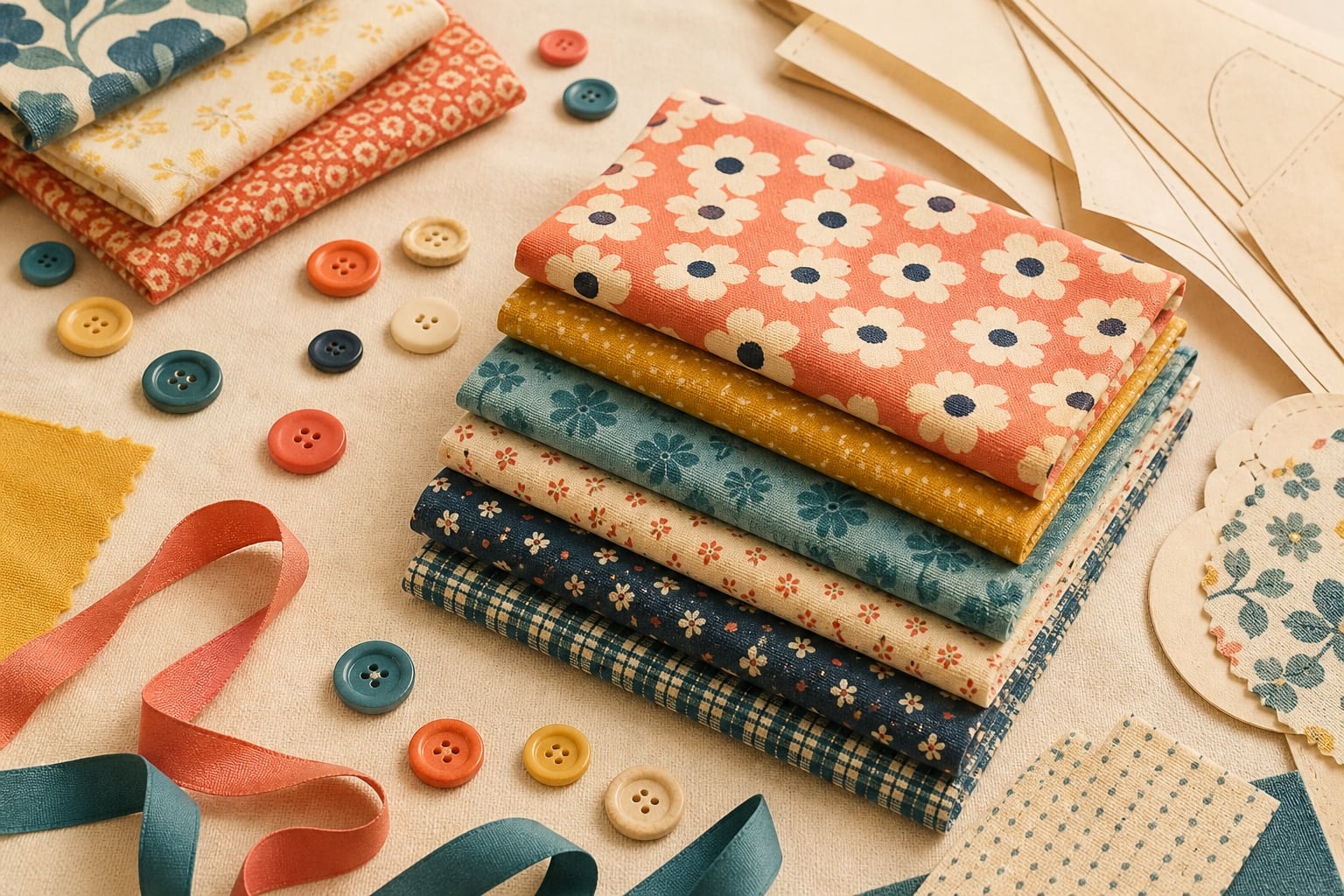
New Arrivals was the catalog’s changing front shelf: a place for recently added fabrics, patterns, buttons, ribbons, and sewing materials. Unlike a permanent department, its sequence shifted as fresh items entered the broader assortment and older entries moved into period, motif, material, or project categories.
A changing assortment
A new-arrivals list gives visual variety priority. A miniature floral might sit beside a bold tropical print, a package of buttons, an apron pattern, or a coated fabric. The common thread is timing rather than subject. That mixture lets readers notice contrasts in scale, palette, surface, and intended use before choosing a more focused department.
Many subjects also belonged to several catalog paths. A dotted cotton could appear under dots and Forties and Fifties; a Japanese import might also belong to florals, children, or vinyl; a quilt pattern could connect patterns with the fabric categories needed for the project. New Arrivals acted as an additional route into that overlapping system.
From broad browsing to close comparison
The fabrics guide organizes textiles by period, motif, material, collection, and project. The dots category shows how closely related repeats can be compared by scale and spacing, while Forties and Fifties fabric groups prints through period-inspired visual language. The buttons page keeps notions distinct from yardage.
Colorways matter when a familiar motif appears in several versions. Ground color can change figure-ground contrast, make a small motif read as texture, or shift the mood of an otherwise identical repeat. Width, fiber, dominant motif size, and repeat dimensions provide useful comparisons when a listing supplies them; a title alone should not be stretched into a technical specification.
Reading names carefully
Catalog names often combine motif and color: a dot in sunflower, a playground print in blue, or a geometric ball design in orange. Such names are concise browsing aids, not complete descriptions. They do not establish current availability, exact screen color, condition, date of manufacture, or suitability for a particular project.
Period labels also describe catalog style rather than proving age. A fifties-inspired novelty can be a later reproduction or revival. Tropical, western, floral, children’s, and modern are similarly broad visual families. Careful reading keeps those category terms useful while leaving maker, origin, and material claims to documentation specific to the textile.
Materials and projects
Fabric was only part of the assortment. Apron and kitchen patterns, quilt patterns, buttons, patches, ribbons, and sewing supplies connected printed cloth with finished projects. Coated materials such as vinyl introduced different handling and care questions, while miniature prints and small repeats suited different scales from broad scenic designs.
The New Arrivals route therefore represents movement across the whole catalog. It connects new additions with stable departments and shows how one object can be browsed by what it is, what it depicts, the period it evokes, the material it uses, or the project it supports.