Bunny Damask Novelty Print: Symmetry with a Playful Motif
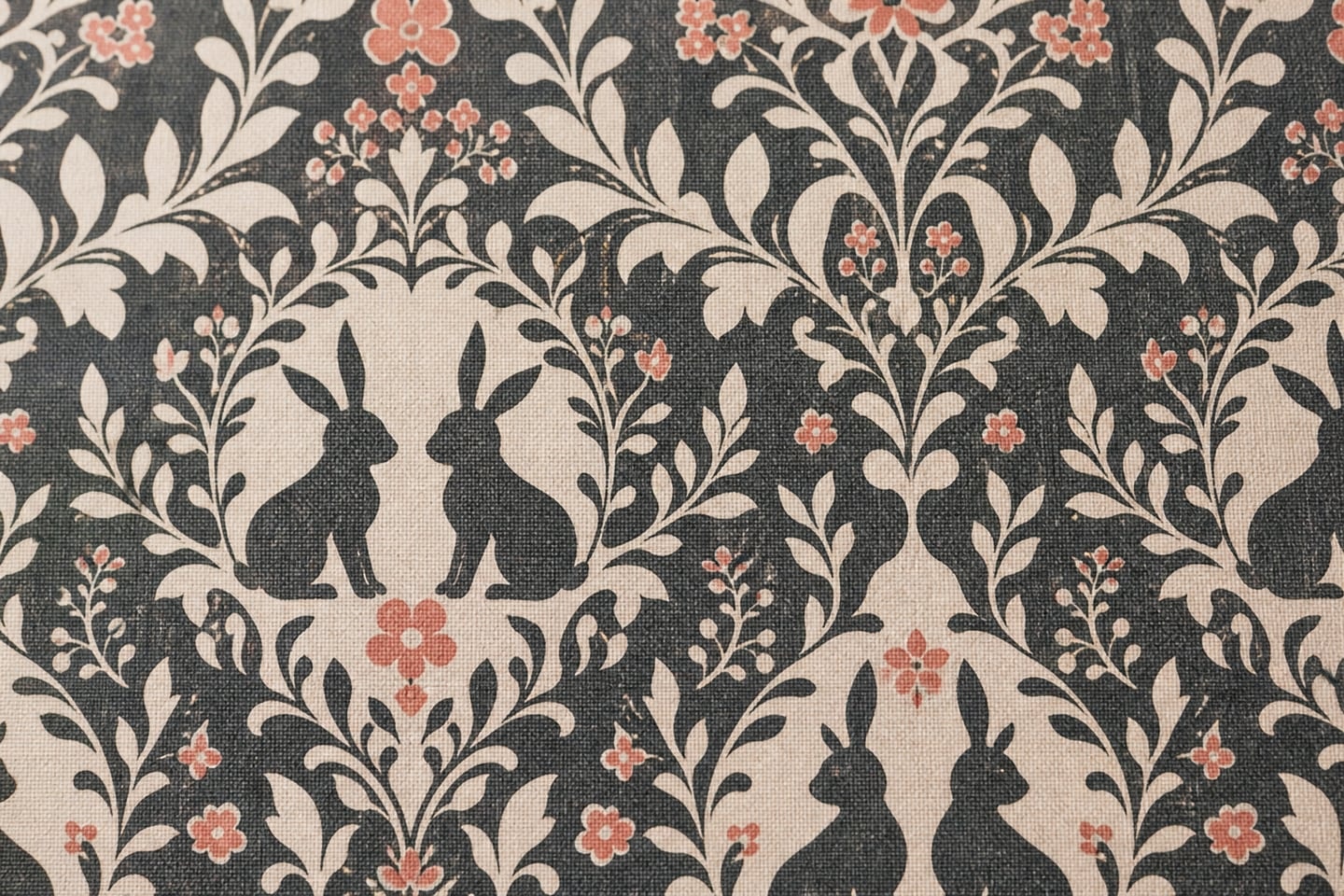
A bunny-and-forest damask motif combines an ordinary animal silhouette with the formal balance of mirrored foliage. The subject offers a useful lesson in repeat, figure and ground, and the difference between structural damask and a print that borrows damask's visual grammar.
Damask can describe structure or appearance
Traditional damask is a reversible figured weave in which contrasting weave structures make the motif visible as light strikes the surface. A printed textile can imitate its formal qualities—symmetry, scrolling forms, medallions, and alternating figure-ground—without being woven as damask. Close views of the front and reverse help distinguish applied color from structure, though expert analysis may still be needed.
Printed-textile methods also have a long technical history. The V&A discussion of early printed textiles shows how an inked unit becomes a repeating surface design. That distinction helps explain how a print can quote damask's visual structure without being woven as damask.
Mirroring creates formality
A damask-like unit often mirrors around a vertical axis. Leaves, branches, or animals face inward, creating a central medallion. Adjacent units may mirror again horizontally or alternate in a half-drop. Even a whimsical bunny silhouette gains a formal bearing when paired symmetrically and enclosed by branching shapes.
To trace the unit, find the centerline first. Notice which elements reflect across it and which bridge into the next repeat. Some motifs appear complete only when two neighboring units are read together. Photograph enough cloth to show at least one full repeat in each direction, then make a tighter detail of the central figure.
Figure, ground, and hidden shapes
High-contrast damask prints can flip visually: at one moment the bunny is the figure, and at another the surrounding ground becomes a tree, arch, or mask-like shape. This reversible attention makes a two-color pattern feel more complex than its palette suggests. Narrow gaps and carefully connected negative spaces are as important as the outlined animal.
Color controls that effect. Dark motifs on a pale ground tend to read as silhouettes. Similar-value colors produce a subtler surface in which the repeat emerges gradually. A small accent can disrupt the traditional two-tone effect and direct attention to eyes, flowers, or other details.
Whimsy without a character identity
Long ears, rounded haunches, and a compact tail can make a generic silhouette readable as a rabbit or bunny. The motif remains an ordinary subject unless evidence establishes a licensed or named character, and no such claim should be made without documentation. The useful question is how few shapes are needed for recognition and how those shapes interact with the repeat.
This approach also applies to other novelty patterns. The western motif reference examines familiar objects arranged as narrative shorthand, while the retro buttons page shows how silhouettes remain legible at very small scale.
Scale and construction planning
A medium damask repeat may need an uninterrupted panel to reveal its mirrored structure. Centering the axis can produce deliberate symmetry, while an off-center crop creates a more casual result. Seams through a central animal can be distracting if the motif is strongly recognizable. Gathered areas compress the branches and may hide the negative-space imagery.
Use a paper frame to examine several crops before committing to a layout. Note the design direction, because a mirrored unit can still have a top and bottom. The general fabric pattern guide explains repeat measurement, dominant motif scale, and directional planning.
Documentation and preservation
Record whether the motif appears printed or woven, the orientation of the repeat, measurements between centerlines, the number of colors, and any registration shifts. Photograph front, reverse, and angled light. Do not interpret uneven color automatically as age; it may come from printing, wear, fading, or surface direction.
The National Park Service textile-care guidance emphasizes clean handling, support, environmental control, and cautious storage. Older fabric should not be sharply folded or exposed to sustained bright light. Unknown dyes, finishes, and fiber blends complicate cleaning, so fragile or significant pieces warrant professional advice.
Structure makes the novelty memorable
A bunny damask print succeeds through contrast: formal symmetry meets a lighthearted subject, and a limited palette supports a surprisingly intricate figure-ground game. That visual structure can be described clearly without assigning an uncertain collection identity or unverified specifications.