Mid-Century Modern Fabric and Pattern Language
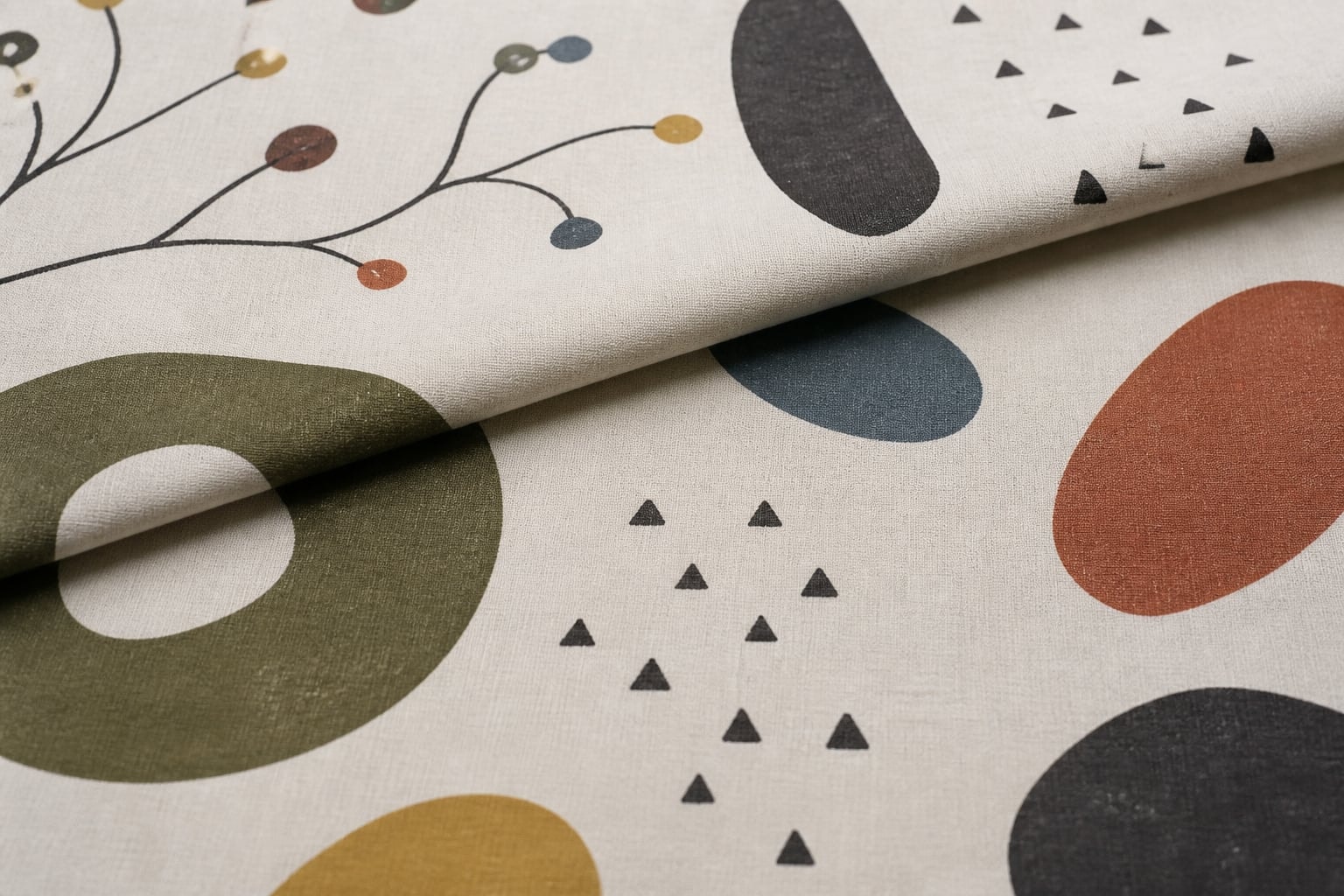
Mid-century modern fabric often feels distinctive through simplified geometry, organic abstraction, active negative space, restrained repeats, and purposeful contrast. These formal devices matter more than any single boomerang, starburst, oval, or botanical shape.
Modern pattern is a relationship, not a motif list
Triangles, lines, ovals, seedpods, and boomerang-like curves are often treated as instant markers of mid-century style. Yet the same shapes can produce very different effects. The important question is how forms relate. Are they balanced on a grid, suspended in open space, clustered into islands, or connected by wandering lines? Does the pattern emphasize repetition or make each unit feel spontaneous?
The V&A history of post-war textiles describes the era's movement between small geometric repeats, science-influenced imagery, organic sources, and bold abstraction. That range cautions against reducing modern textile design to a single familiar symbol.
Geometry softened by variation
A strict grid communicates stability. Slight changes in angle, thickness, spacing, or contour can soften it without removing structure. Many effective modern patterns balance precision and irregularity: a line repeats but bends differently, or a cluster maintains its overall size while its internal pieces shift. This controlled variation creates energy and preserves evidence of the drawing hand.
Negative space participates in the design. Broad areas of ground allow individual forms to breathe and can make a medium repeat feel larger. Closely packed units create a denser surface that becomes almost textural at distance. When studying a fragment, it is worth measuring the empty intervals as carefully as the motifs.
Organic abstraction
Modern prints often simplify natural sources without becoming literal botanical illustrations. A leaf may be reduced to an asymmetric oval and vein. Pebbles may become nested shapes. Branches may appear as branching lines with no identifiable species. The result keeps the movement and growth of nature while allowing the repeat to operate as an abstract composition.
This distinction helps separate visual observation from unsupported naming. Describing a form as leaf-like or cellular acknowledges resemblance. Declaring the exact source or creator would require documentation. The broader method in the fabric motif and repeat guide offers a consistent vocabulary for uncertain examples.
Palette and value structure
Mid-century-inspired palettes can be earthy, bright, monochrome, or sharply contrasted. Olive, rust, mustard, teal, black, cream, and muted blue are familiar associations, but hue names alone do not create the style. Proportion and value establish hierarchy. A pale ground with sparse dark lines feels airy; a dark ground with compact bright forms feels more graphic and enclosed.
Test the value structure in grayscale and the color structure through small isolation windows. Cover most of the design and compare two adjacent areas. This makes it easier to see whether an accent is truly rare or simply appears dominant because it is highly saturated. The canary yellow reference demonstrates how one forceful hue changes according to its neighboring values.
Scale, cropping, and constructed form
A modern pattern can change dramatically when cut. Large open forms may become intriguing fragments across narrow panels, but important relationships can disappear at seams. Small repeats remain legible across compact pieces and tolerate gathers more easily. Directional lines can guide the eye vertically, horizontally, or diagonally, affecting the perceived proportions of a finished form.
Photographing a textile both flat and lightly draped reveals these changes. The flat view documents the repeat; the draped view shows how folds compress space and bring separated colors together. Avoid pinning an older fragment merely for display, and support its full weight during handling.
Careful records, careful claims
A responsible textile record describes visible features and marks interpretation explicitly. The new arrivals guide places modern pattern within a wider catalog taxonomy that also includes period, motif, material, and project categories.
For physical fragments, record dimensions, repeat, apparent direction, front and reverse, surface condition, and lighting. The National Park Service textile-care guidance is a useful authority for supported handling and appropriate storage principles. Fragile or significant objects warrant professional conservation advice.
Modernity through disciplined looking
Mid-century modern fabric is best understood through relationships: geometry and irregularity, motif and ground, color and value, repeat and crop. Reading those relationships closely produces an informative account even when attribution is unavailable—and prevents an evocative style from being mistaken for a proven date or identity.